
India: Bicycles in the 19th Century


“Pagal ki Gadi” is what the Indians called bicycles when these were brought into the British Raj in early nineteenth century.[1] This was reported in 1825. These bicycles were without pedals and therefore are not considered by some as true bicycles[2] but these were the early forms of the machine.
Early Mentions
The velocipedes (cycles) were introduced into India much earlier than stated by several authors and websites. Some say, like the article “How Cycle Mechanics Helped India Move” by Amanda Lanzillo and Arun Kumar published in The Wire on 1 August 2023,[3] that these were imported and used in the 1860s, while others push the arrival year forward to late nineteenth century.[4] True, bicycles were imported but much earlier than mentioned in the article.
In 1819-20, it seems that cycles were being used by several British residents in Calcutta. This is just a few years after its invention. These riders were proving to be a nuisance at public places in Calcutta. The Governor General then issued a directive of banning the entry of these bicycles to the Respondentia Walk.[5] It is said, “It would seem that the dandies of Calcutta, mounted on their velocipedes, have become rather troublesome to the worthy citizens of that metropolis.”[6] Respondentia Walk was a street along the river that extended from Fort William to Chandpal Ghat where it joined the Strand road.[7]
By the 1830s young Europeans would ride their cycles from Calcutta to Cox’s Bungalow. The latter was a hunting meet located a few miles from Calcutta at the time.[8] Emma Roberts, writing in the early 1830s, mentions that young men would ride to the Cox’s bungalow in the morning and return by evening and that this ride was a very exhaustive one.[9]
Initially, it was the English army personnel who brought bicycles from England to India which they put on sale when they completed their stint in India. Advertisements and notifications of sale of household goods by army officers along with cycles are found quite often in contemporary periodicals. One officer, stationed at Moradabad in 1876, owned one Coventry made bicycle (Coventry hosted several cycle manufacturers) which had a 46-inch driving wheel, rubber tyres, leather bag, footrests and a canopy which he was selling at Rs 120. His other machine was a spider bicycle with a 50-inch driving wheel, bright steel spokes, bag, brake etc, for which he was asking the same price. The Spider bicycle was a unique machine which had a large front wheel and small one in the rear and it had wire spokes instead of the wooden ones used earlier. [10]
In the late 1860s, 1869 to be precise, an English officer in central India saw his compatriot bring a cycle from England to this cantonment in central India. The gentleman practised riding his cycle by going round in circles in front of his bungalow. Soon others in the cantonment got themselves these two-wheeled invention and practised riding their vehicles in and around their compounds. The author soon got himself a bicycle. And at that time the bicycle seemed to be “a light and elegant vehicle, resplendent with varnish and polished steel.” [11] The author then describes how he learnt to balance on the bicycle by first going down an incline and once he mastered the art of balancing, he found that he could easily ride it around and soon was riding it on the cantonment roads much to the excitement of the kids. However, the adults were not too happy with the cycles on the cantonment roads. The bicycle startled horses which were the common mode of transportation at the time and once both a lady and the horse she was riding got startled by the author on his bicycle which resulted in the authorities ordering the bicycles off the cantonment roads. The author and other bicycle riders remonstrated to the authorities pointing out how difficult it was to ride cycles anywhere else and then a compromise was achieved where it was agreed that the bicyclists would have to avoid carriages and horse riders. The author goes on to mention how policemen would clear the roads in crowded bazars for the riders and the Indians would mistake him for a senior officer and at times present petitions to him. However, he found that the heat of an Indian summer caused him and the bicycle lot of trouble:
“My bicycling ardor did not last long in India. With the thermometer ranging from 95° to 105° degrees in the shade, the process of riding a bone-shaker, when one is not used to it, is attended with some fatigue and much moisture… One of the chief difficulties I found was to keep the machine in working order. The intense heat caused the wooden felloes and spokes to shrink and crack, and the wheels required constant repair.” [12]
At the end of his first stint in India the author remarks that the bicycle “elsewhere, as well as in India, did not turn out to be all that fancy had painted it.” [13]
The author returns to India in 1878. In the interim new bicycles had been introduced, and the author purchased one which was 50 inches high, higher than his old one which was 36 inches. He preferred the high one for long distances and speedy rides whereas he found the short one, the old one, “on scores of safety, convenience in mounting and dismounting, and comfort on rough roads,” [14] having many advantages over the high one. For his second stint in India, he carried his old bicycle. His account of quality of roads in India and use of bicycles during this time makes for an interesting read:
“The roads of an Indian cantonment are probably the best for cycling in the world. Usually very level, they are made with a hard clay containing a good deal of iron, and this clay, broken down, mixed with water, well pounded, and baked by a tropical sun, makes a road as smooth as it were of cement. Bicycles and tricycles are common in the large towns, and both have penetrated to remote stations, the latter being most favored as aids to locomotion. Tricycles are seldom ridden for amusement in India.” [15]
Residing in Saharanpur during his second stint to India, the author even rides his bicycle all the way to Mussoorie. His describes how during the steep sections of the route he had to dismount and walk while pushing the cycle with his hands. This journey to Mussoorie and back was accomplished in three days, with night halts at a rest house along the way up and at Mussoorie. The return journey was a breeze as it was mostly travelling downhill.[16]
Another article in the Friend of India of 1881 spoke highly of the roads in India and their suitableness for riding bicycles:
“Of all the roads of the world there is none for the bicyclist equal to the kunkur road of the Upper Provinces. For smoothness and elasticity, it is only inferior to asphalte. Not only is the harsh vibration and the frequent jolting of macadam avoided on a kunkur road, but the tires of the wheels escape being out to pieces by the small flints – a very important matter in India, where new tires are not procurable, or, if procured from home, are almost impossible for the ordinary bicyclist to fix on. Then, again, the Indian road is perfectly level, and the result of this, and of its smoothness is that the bicycle, once set going, runs almost of itself. Friction is very trifling, jolts there are none, and if the rider is content to travel a moderate pace, say eight miles an hour, he may ride for many hours on a stretch in the present season, without more fatigue than in England, notwithstanding the difference in the air, temperature, and the scenery.”[17] In mid 1880s, Thomas Stevens, first person to ride a bicycle around the world, rode from Lahore to Calcutta on this tour. He, too, approved of the quality of roads, especially the Grand Trunk Road, stating that “it is a magnificent road to bicycle over; not only is it broad, level and smooth, but for much of the way it is converted into a veritable avenue by spreading shade-trees on either side.”[18]
Cycles and Excursions
By 1869, bicycles were no longer a rare sight. People, especially the English, had taken to the new mode quite comfortably, even taking the vehicle on long trips. The ride to Mussoorie by Douglass, given above, took place in the late 1870s. However, undertaking long journeys on the bicycle from one place to another as a leisure activity had started gaining attention a decade earlier – that is by the end of 1860s. Three Englishmen rode their bicycles from Lucknow to Kanpur and managed to attain a speed of ten miles an hour for some parts of the journey. Since it was a leisure trip, the riders took smoking breaks along the route despite which they averaged seven miles an hour speed.[19] Another one reported by the Deccan Herald was from Pune to Khandala by a British sergeant who completed the journey in 3 hours 50minutes.[20]
Another long journey was reported from Mysore where a Christian missionary travelled on a bicycle from Bangalore to Shimoga (Shivamogga today) which took him three days to complete. From Shivamogga he rode his bicycle to a certain Garaapa falls which is most likely the Jog Falls which were called Gersoppa Falls then. He took two days from Shivamogga to the falls and back to Shivamogga. The reaction of the Indians living in rural parts who witnessed this gentleman travelling on a new contraption of a vehicle was varied – some thought he was the Governor General visiting the area, while others thought he was an acrobat.[21]
Bicycles were used at hill stations too despite being a difficult proposition when going uphill. Simla in fact had limited bicycling riding to a particular road while bicycles were allowed in Ooty and Coonoor.[22]
Indians and Bicycles
In early 1870s, bicycles were reported as being “a favourite medium of locomotion in Madras,” especially for clerks. The same news report points out how all other modes of conveyance by regulation were to have lights at night but not the bicycle when their use is a “rule not an exception”.[23] Clearly bicycles were a common sight. Since bicycles, and also, tricycles, were imported they were taxed and placed in the trade returns under “carriages and carts and parts thereof.”[24] This clubbing of bicycles with carriages and carts in the trade returns has, therefore, resulted in the absence of information regarding import of bicycles into India. Bicycles were sent to India with their pedals removed,[25] which were attached later after their delivery.
In 1869, W. L. Atkinson and Co., a retailer in Calcutta, began advertising sale of bicycles and tricycles. One such was a tricycle convertible into bicycle which was priced at Rs 105.[26] Soon, in 1872, the postal department of the North-Western Provinces (Uttar Pradesh of today) had their delivery peons deliver posts on bicycles in the cities of Allahabad, Kanpur and Agra.[27] Pune began providing their peons with bicycles in 1873.[28]
A news report of 1888 mentions that the Parsees took to the cycles easily whereas the Hindus stayed away from the contraption.[29] However, a letter in 1889 to the Cyclist magazine by a resident of Bombay qualifies by stating that the Parsees rode the tricycles more than bicycles. Whereas the others in small numbers rode the bicycles. The writer finds a Hindu on a bicycle a curious thing: “Fancy a man dressed in a long coat and loin cloth, with bare legs, and his feet in turned up slippers, bestriding a tall machine. How they manage to mount is quite a mystery to me, their toes only being loosely fixed into the slippers.”[30] The writer uses the word “native” in his letter, whereas he mentions the Parsi separately; since the man described is wearing a loin cloth, he is clearly a Hindu.
The image below is of a bone-shaker as used in 1870s in England. In India, a similar kind would have been in use.
Image 1: “Bone-Shaker”

Source: H. Hewitt Griffin, Cycles and Cycling (London” George Bell & Sons, 1903), 38
Another illustration that confirms the use of bicycles by Indians is the existence of cycle repair shops run by Indians in the 1870s. This happened in Dacca at the Dacca College. An interesting case occurred in 1877 when a white man’s bicycle was damaged by an Indian gymnastic teacher when he tried to ride it while it was left standing unattended in the compound of the Dacca College. The damaged bicycle was repaired in a local repair shop for two rupees paid for by the Indian teacher.[31]
An article published towards the end of the nineteenth century claimed that the Indians began using bicycles much later. The description given in the article below mockingly presents Indian riders and their gear while riding:
“Wheeling has been in vogue for many years in Calcutta, but it only very lately that the natives have caught the craze. A few years ago, a native astride a bicycle was an unusual sight, but now ‘bikists’ in white, flowing chuddees, or clad in hybrid half-European costumes, are in evidence on all the wider streets and maidan roads of an evening. Many of these ‘scorchers’ have taken to pneumatic tyres, but the majority seem to prefer cushion-tyred wheels; while those who cannot afford the more expensive types of machines make a brave show on ancient solid-tyred safeties in an advanced stage of decay, and noisy enough to render quite unnecessary the use of a bell. Among the older men, too, there are many enthusiastic cyclists. But they take life more seriously, and with commendable caution select the ‘three-wheeler’ as a safer mount, and one on which they can rest, if necessary, without dismounting; the latter being a consideration to be taken into account when the weight of the rider approaches sixteen or seventeen stone.
These sedate old gentlemen never hurry through their morning constitutional, but pedal slowly along the less-frequented roads, carefully guiding their old-fashioned mounts with one hand, while with the other they hold up an open umbrella as a protection for their uncovered heads.”[32]
The same article then reproduces a letter written by a young Indian to a senior gentleman, most likely his relative, asking for a bicycle as a gift. “Most respected Sir, I fall at your feet. If you please, save my life and make me happy. I have the strongest desire to have Bisicle to ride on. Through the contemplation I have no sleep either in the day or in the night. I have been reduced to half, and if I continue the same course, I do not know what my fate will be… I have become like a helpless, sick man, and you have become a doctor. If you give me medicine I shall recover, otherwise not…. Please be kind to me … and let your kind heart and noble mind order your generous hands to present this poor man with a beautiful bisickle.”[33]
While only three months of the year viz., December, January and February, and early morning hours during summer were favourable for European cyclists, Indians rode cycles all year round, even in the sweltering heat of summer.[34]
Image 2: A Native on a tricycle

Source: “Note Book,” The Boy’s Own Annual, Vol 18 (London: 1895), 735. https://www.google.co.in/books/edition/The_Boy_s_Own_Annual/X745AQAAMAAJ?hl=en&gbpv=0
The Chinese of Calcutta took to the cycle with great interest. It is reported that they bought brand new machines and demanded a two-year guarantee for the machine while the “ordinary Hindu and Mohammedan cyclist is quite satisfied to start his wheeling career with an old crock painted in imitation of a rainbow.”[35]
Bicycle Manufacturing
By 1880s, bicycles were being made and supplied by the post-office workshops at Aligarh. In 1880, the Aligarh postal workshop built nine bicycles in the year.[36] These cycles were “rude machines, only a slight improvement upon the honored boneshaker.” They were “strong, heavy bicycles” and were supplied to the Indian postmen at Kanpur and Allahabad.[37] Another news article written in 1895 states that fifteen years before, that would be early 1880s or slightly before, a public works department superintending engineer had provided “native made boneshakers” to his subordinates and they would accompany him in his inspection rounds on these bicycles quite willingly. These bicycles did not come into popular use; so, the author questioned the engineer about the failure of these boneshakers from becoming a common mode of transportation if they were not so bad. However, the engineer could not provide any satisfactory reasons for their failures. The author concludes that the subordinates “had devoted themselves to the mastery of the fiery untamed bone-shaker as willingly as they would have encountered any other sacrifice of their personal comfort for the purpose of humouring the little peculiarities of the Sahib.” He then attributes the failure of this project to the machines being bone-shakers and “even upon the Grand Trunk and cantonment roads, must have subjected their riders to some very palpable inconvenience.”[38]
A small account of the postal department workshop will help us to understand the reason for manufacture of bicycles at the place. In 1843, Dr Paton, the Postmaster General of India, established workshops when the old method of sending mails through runners was replaced by wheeled vehicles like carriages, carts and wagons. These vehicles became successful and soon the Aligarh workshops were supplying these vehicles across India. Besides, these vehicles, the workshops also began producing bags, stamps and other goods.[39] For building wagons, carriages and carts, these workshops would have had in employment skilled smiths, carpenters etc who could easily put together a bicycle when the need arose for equipping postmen with bicycles. And they would have supplied bicycles to private people too at the right price. In fact, later, in 1890, the Upper India Chamber of Commerce at Kanpur, members of which were British entrepreneurs and officers, demanded the closure of the Aligarh workshop as the goods being rolled out were giving stiff competition to the products of the factories located in Kanpur. It was argued that “it was the duty of the State to encourage private enterprise; and not by the aid of its practically unlimited capital to compete with and crush it.”[40]
In 1890, it was proposed that cycles be introduced in the cantonment of Bangalore for the use of military orderlies who did duties in several military offices located there.[41] At the same station, Brigadier General Bengough placed an order of two cycles from the Aligarh Postal workshop at the cost of Rs 200 to start a cyclist corps in Bangalore.[42]
Mishaps
Accidents of various kinds involving bicycles were reported in newspapers of the nineteenth century. In 1869, a young man went cycling in Royapet and Narsingapuram areas of Madras (now Chennai) but had barely gone some yards that he toppled over “covering the luckless rider with a fair share of Mount Road dust.”[43] Some were tragic such as the accident of a young English youth of 18 years who while riding from Pune to Satara, in 1881, lost control of his bicycle while descending the hills. The bicycle gained tremendous speed and then hurled over the edge into the valley below. Eyewitness account describes the boy being found wounded and unconscious, and the bicycle had lost its wheels.[44] In 1883, the young Maharaja of Patiala met with an accident while riding his bicycle. He received a concussion in his head which looked like a serious injury initially, but he recovered from the accident.[45] Horses and ponies genuinely got a fright because of these bicycles. It is reported that ladies on ponies were given a fright by their ponies being frightened at the sight of a bicycle rider who would not stop his machine on seeing the ladies on the pony.[46] In Madras, a young man while riding his bicycle on the Adyar Road hit an oncoming horse carriage which knocked the cyclist down causing a fracture to his right elbow.[47] The use of India rubber tyres on cycles, which became a common feature in cycles sometime in the early 1870s,[48] made them nearly noiseless, thereby startling many a pedestrians and horses having riders on their backs or pulling carriages behind them, resulting in mishaps.[49]
Cycling and Health
By the 1880s, cycling, either on bicycles or tricycles, was being promoted as a good form of exercise for both sexes. A pamphlet supposedly published by a Parsi Doctor was being distributed in Mumbai that promoted the beneficial impact on health of riding bicycles or tricycles in moderation.[50] Thomas Stevens in his account of riding a bicycle round the world relates the health benefits from cycling as told to him by a British officer based in Jallandhar. This British officer cured his enlarged spleen by riding a tricycle. Once cured, he sold the tricycle to an Indian who had a similar medical problem, and he, too, was cured of the problem.[51]
Cycling and Recreation
By the end of 1860s, bicycle races became a form of recreation. In Bombay this race took place sometime at the end of 1869, and a month later a bicycle race took place in Allahabad (now Prayag). The Times of India sarcastically countered the reporting by the Pioneer (Allahabad based paper) regarding Allahabad hosting the first bicycle races in the country:
“’Henceforth,” sings the Pioneer, “Allahabad will be distinguished among Indian cities as the first to inaugurate Bicycle Races. The first meeting of the kind is to come of on the 18th near the High Court, at 3 p.m. There are seven events on the card, and local residents may expect some sport.’ We are sorry to disillusion the young people of Allahabad; but Bombay had bicycle races a full month ago.”[52]
In 1884, on Athlete Sports Day at Ballygunge Cricket Club, bicycle race was one of the events[53] and it became part of this annual sporting event.[54] Soon sporting clubs specifically for bicycling were established. In 1886, there existed a Dalhousie Athletic and Bicycle Club in Calcutta.[55] While another source mentions formation of two bicycle clubs – the Naval Volunteer Cycling Club and the Company F Calcutta Rifle Volunteer Cycling Club.[56] By the end of the century, Bicycle polo was being played on the Ballygunge cricket ground.[57]
Even in the entertainment space, the bicycle became prop for skits, dances and other performances.[58]
Magazines carried articles, and even supplements, on cycling,[59] on suggestions and guidance on various aspects of bicycling in India. One such was on bicycling long distances which mentioned the most appropriate outfit for the ride.
“A stout canvas valise fitting snugly in the frame, a fair sized bag on the handle bar, over which a rug, air pillow and water proof covering are strapped in a tight roll, and lastly a capacious fest covered water bottle slung under the saddle. The latter, if occasionally wetted, will be found to keep the liquid contents (cold tea and lime for preferences) wonderfully cool and refreshing. In the bag a complete change of clothing, extra flannel vests, spare shoes, a cap, two towels, a sleeping snit, soap, razor, brush and comb, a mosquito net, and etceteras can be easily carried. This kit will average about 20lb., including the bags. As a stand by, when the worst comes to the worst, a few coca lozenges, a couple of tins of ‘Brands’s extract,’ and a flask of brandy will be found invaluable. When nothing can be got, save milk and eggs, good ‘flip’ will sustain one for hours, while merits of coca are too well known to need repeating. Tea and sugar should always be carried and a spare bottle of lubricant, for it is difficult to get anything but mustard oil when once the towns are left behind.”[60]
Riders from other countries begam touring the world on the bicycle. Thomas Stevens, already been mentioned above, was the first one to tour around the world on a bicycle. This feat was done in 1884-85 and he entered India from the west and departed via Calcutta. In his account he describes seeing an Indian with a big red turban and white clothes riding a bone-shaker – which was sobriquet for the bicycle which neither had a rubber tyre nor the pneumatic ones to cushion the rider from the shaking of bones. This Punjabi rider was accompanying a British officer who was astride on a modern imported bicycle while the former was on a bone-shaker that was made in India.[61]
Image 3: Street in India

Source: Thomas Stevens, “Around the World on a Bicycle: Through India XXVII,” Outing: An Illustrated Monthly Magazine of Recreation, Vol XI, October, 1887 – March, 1888 (New York), 357-371.
Ten years later, Frank G. Lenz, an American cyclist commenced on a world tour on his bicycle in collaboration with the Outing magazine. He began his tour in May 1892 from New York and reached Calcutta – a tour which included three sea voyages and crossing of China and Burma.[62] From Calcutta he rode to Amritsar, via Benares, Allahabad, Kanpur, Aligarh, Delhi, etc., and then on to Lahore. His route was largely along the Grand Trunk Road.
“Bicycling was introduced years ago in India, when the ordinary high wheel was considered perfection. To-day there are over two hundred wheelmen in Calcutta. Two bicycle clubs have been formed within the last two years – the Calcutta Naval Volunteer Cycling Club, and the Company F Calcutta Rifle Volunteer Cycling Club. There are, of course, no bicycle records held in India, but a very creditable performance was accomplished by W. S. Burke and A. J. Millwood, riding from Allahabad to Calcutta, a distance of five hundred and thirty miles in five and a half days, in October, 1892.”[63]
Besides the curious Indian onlookers and the cyclists, the photographs taken by Lenz along the route in India also provide us visuals of the Grand Trunk Road of the 1890s.
Image 4: Hindu Critics

Source: “Lenz’s World Tour Awheel: Rangoon, Burma to Calcutta, India,” Outing: An Illustrated Monthly Magazine of Sport, Travel and Recreation, Vol XXVI, June 1895, issue no. 3, 224-228. https://archive.org/details/sim_outing-sport-adventure-travel-fiction_1895-06_26_3_0/page/228/mode/2up, 222-228.
Image 5: Lenz with his Calcutta Escort
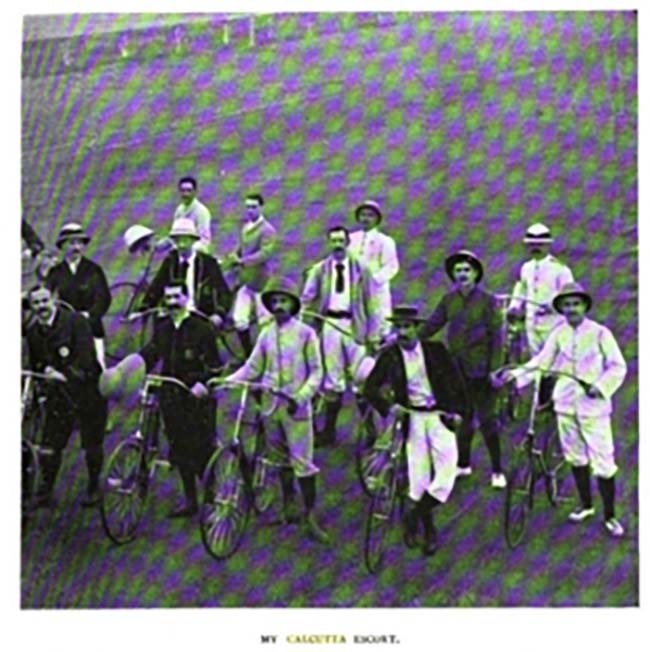
Source: “Lenz’s World Tour Awheel: Rangoon, Burma to Calcutta, India,” Outing: An Illustrated Monthly Magazine of Sport, Travel and Recreation, Vol XXVI, June 1895, issue no. 3, 222-228.
Image 6: Lenz on the Grand Trunk Road

Source: “Lenz’s World Tour Awheel: Calcutta to Allahabad,” Outing: An Illustrated Monthly Magazine of Sport, Travel and Recreation, Vol XXVI, July 1895, issue no. 4, 295-300. https://archive.org/details/sim_outing-sport-adventure-travel-fiction_1895-07_26_4/mode/2up.
Image 7: Lenz on a bench somewhere in India

Source: “Lenz’s World Tour Awheel: Calcutta to Allahabad,” Outing: An Illustrated Monthly Magazine of Sport, Travel and Recreation, Vol XXVI, July 1895, issue no. 4, 295-300.
Image 8: Lenz meets a camel cart
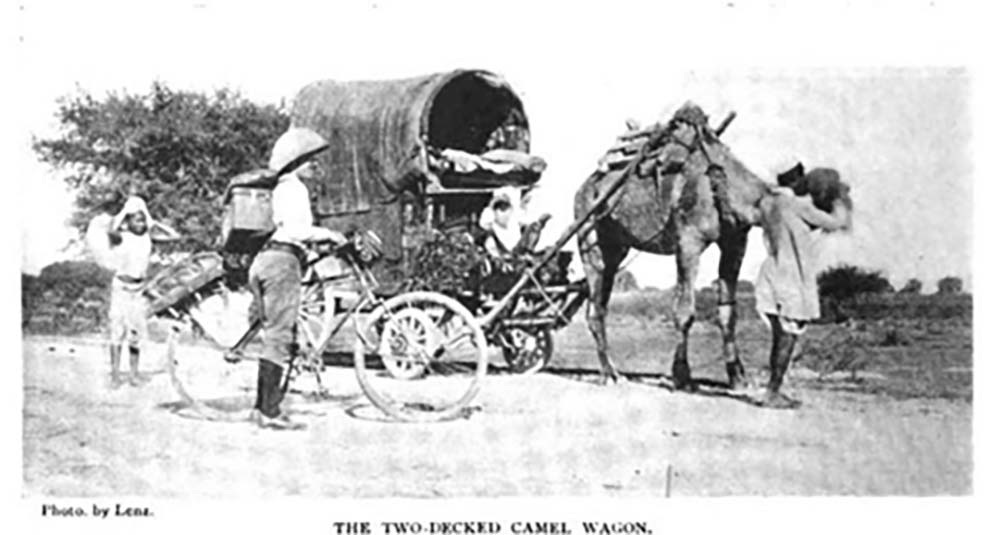
Source: “Lenz’s World Tour Awheel: Cawnpore to Agra,” Outing: An Illustrated Monthly Magazine of Sport, Travel and Recreation, Vol XXVI, September 1895, no. 6, 467-470. https://archive.org/details/sim_outing-sport-adventure-travel-fiction_1895-09_26_6_0/page/468/mode/2up. Photograph was taken somewhere between Kanpur and Agra.
Image 9: Lenz sitting near a Milestone with Allahabad marked
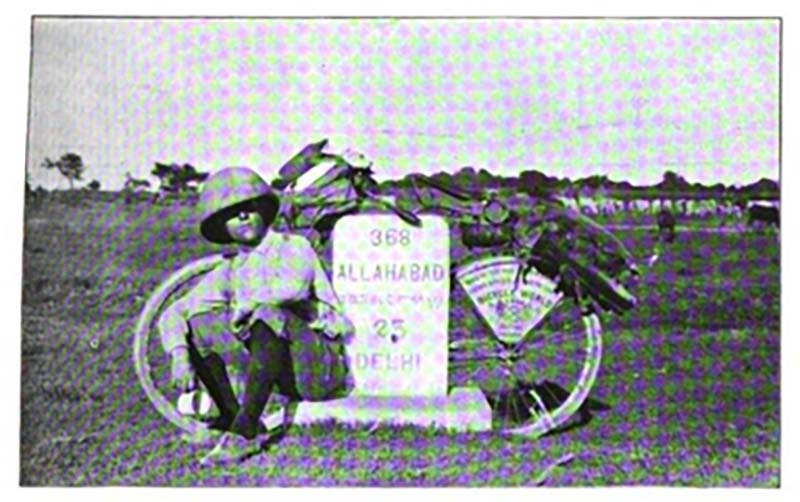
Source: “Lenz’s World Tour Awheel,” Outing: An Illustrated Monthly Magazine of Sport, Travel and Recreation, Vol XXVII, October, 1895, Issue no. 1, 51-55. https://archive.org/details/sim_outing-sport-adventure-travel-fiction_1895-10_27_1_0/page/n111/mode/2up. This photograph was taken somewhere between Agra and Delhi.
Image 10: Lenz meets two military men with bicycles

Source: “Lenz’s World Tour Awheel,” Outing: An Illustrated Monthly Magazine of Sport, Travel and Recreation, Vol XXVII, , October 1895, Issue no. 1, 51-55. Photograph was taken somewhere between Agra and Delhi.
Image 11: Lenz meets soldiers on horses

Source: “Lenz’s World Tour Awheel,” Outing: An Illustrated Monthly Magazine of Sport, Travel and Recreation, Vol XXVII, November 1895, issue no. 2, 140-144. https://archive.org/details/sim_outing-sport-adventure-travel-fiction_1895-11_27_2/page/n1/mode/2up. Lenz comes across soldiers on horses somewhere near Ludhiana.
Tragically, Lenz, who was just 27 years old, lost his life during this world tour. When he crossed into Turkey he was shot dead some 50 miles before Erzeroum.[64]
Tax of Cycles
With the number of cyclists increasing, municipalities soon included the bicycle in the list of vehicles to be taxed. As early as 1874, The finance sub-committee of Bassein (now Vasai, near Mumbai) proposed to impose a tax on bicycles terming them as mere luxuries and that they damage the roads. The editor of the newspaper mocked that a committee which possesses just two hack-gharries was calling bicycles as damaging to roads.[65]
In 1895, the Madras municipality was taken to court by one gentleman against tax on bicycles, but the Egmore magistrate passed an order supporting the municipality.[66] In Bombay, in the year 1898, 444 bicycles and 15 tricycles were taxed but these numbers were erroneous, as commented by a member of the Bombay Corporation, because according to just one cycle retailer in the city there were more than three thousand cycles in Bombay.[67] In Calcutta, in the late 1890s, there were nearly 3000 cyclists which were enumerated in the tax list.[68]
Image 12: An Indian on a bicycle in front of the Singer Sewing Machine company outlet in Bombay.

Source: The Story of the Sewing Machine, by The Singer Manufacturing Company (Press of F. V. Strauss, 1897), 29.
Cycles and Law
There were reports of bicycle thefts in Calcutta where the thieves would ride off with the bicycles.[69] The thieves were usually Indians and if they could ride the cycles while thieving, they obviously learnt the art of balancing before the act.
As expected, the flexibility of use inherent in the bicycle, especially in its size and weight and maintenance when compared to other forms of transportation in use at the time such as horses, bullock carts, palanquins, etc., brought with it a nuisance value, the most common being their encroachment into pedestrian spaces such as footpaths. Notices had to be put up at “nearly all the public footpaths skirting the Maidan” prohibiting cyclists from riding on the footpaths. However, cyclists ignored the orders, and several rode their bicycles on these footpaths causing “danger and annoyance to the pedestrians.” A complainant describes how he saw a lady and a man riding their cycles on the footpath which ran “parallel to the Maidan between Park Street and Harrington Street” and when the man saw some Indians walking on the footpath ahead of them, he waved his hand to ask them to get off the path and make way for the riders which they did.[70]
Women and Cycles
As for women riding bicycles in India, it is reported that till a few years before 1896, a woman rider would be seen occasionally on Calcutta roads. But in 1896, the same source states, that women riders had suddenly grown in numbers, as if “bitten by a mania.”[71] The growing interest in cycling amongst the fairer sex naturally brought with it the problems faced by men riders earlier. Cases of thefts and fraud were par for the course. A interesting case took place in Calcutta where, in 1897, a European lady filed a case against a cycle repair shop for retaining her bicycle for an inordinate time during which time it lent it out to another woman to ride it around Calcutta, thereby ruining the cycle in the process.[72] Further, there were bicycle races for women.[73] Even in a remote place like Silchar in the Cacher district of Assam, bicycle races for ladies were held, the first one being in 1899.[74]
Importation and Brands of Cycles
In 1893, an article in an American sporting magazine provides some details on import of cycles into India. The author of the article is surprised to see a significant number of cycles on the roads in India, more than he had anticipated. His observations were that a “considerable number of the Europeans in the great cities of Bombay, Calcutta and Madras” kept cycles and there were several cycling clubs that were flourishing at the time of his visit. The author got a chance to ride around Bombay with the captain of the Bombay Bicycling Club. As for the Indians he writes that “cycling was only in its infancy among them,” and that the Indians were “taking to the use of the wheel, especially the tricycle.” He adds that the Rajas were not “averse to the possession of a cycle.” He states that all three cities – Calcutta, Bombay and Madras, had cycle dealers and that, when he visited, there were no duties on the newer, improved version of the cycles. He further says that there were no local manufacturing concerns of cycles in India.[75]
By the 1880s, the bicycle was referred to as the “Ghora,” short for “Loha Ghora,” or Iron Horse.[76] Retailers such as Maynard, Harris & Co sold well known brands of bicycles and tricycles such as the Premier, Sparkbrook, National, and Rucher.[77] There was Marck and Co in Bombay and Pune that retailed Premier cycles, a company that manufactured 33,000 cycles a year.[78] Another one, J. A. Kirkbride and Co, located on Tamarind Lane in Bombay sold bicycles of various brands such as Elswick, Columbia (American brand), Quadrant and Rudge-Whitworth.[79]
Image 13: Advertisements by bicycle retailers

Source: F. M. Coleman, Typical Pictures of Indian Natives in Colours (Bombay: Times of India and Thackery & Co, 1897), viii advertisement pages.
Indian Syce
By the close of the nineteenth century, bicycles were seen aplenty on the streets of Calcutta and other places. The Indians were almost always treated with contempt and exploited even where bicycling was involved.
Most government officers would have their Indian servants bring their cycles to the office to ride home after work. The source says these servants would first ride the bicycles to office and then rush back to help in the preparation of dinner for their “sahibs”.[80] Though only the evening routine is mentioned in the source, the office-goer would have used his cycle in the morning too causing the Indian servants to walk one way of the trip. What also comes out of this account is that cycles were not safe when parked at the office buildings. Further, the author of the same article states in jest that it would not be a wonder if the Hindu shastras were to suddenly forbid use of bicycles just to provide the Indian servant respite from this duty.
The Indian domestic servant who was given charge of the cycles was called a syce or a bearer and was almost always painted as a rascal when it came to taking care of the cycles. “Put him in absolute charge of a bicycle, and he will do his best to damage the machine and endanger the safety of its rider. He will take a fiendish pride in scratching the enamel; if he can loosen a nut, he does so gladly; he will deluge the machine with water to the destruction of the tyres and the rusting of the working parts; if he can strip off the nickel plating wholesale, his joy is perfect. In short, he regards a bicycle committed to his care as something to be rendered unserviceable and unsightly as rapidly as possible, and if left to his own devices., he completely carries out his theory.” [81]
Cyclists- The Scorchers, The Wobbler, and The Steady Goer
With growing familiarity with the machine and the increasing confidence in the art of balancing on the bicycles resulted in young men doing all kinds of risky things with their bicycles. The term “scorcher” has been mentioned above in this article, the origin of which is from the antics performed by the bicyclists on them while riding on the roads of Calcutta. There exists a funny exchange of opinions regarding different types of cyclists between citizens of Calcutta, two of them being cyclists. In the late 1890s, there were two kinds of cyclists – the Wobbler and the Scorcher. The three gentlemen writers signed off their letters as Wobbler, Old Roadster and Steady Goer – the first two names associated with bicycling. Below is a reproduction of pertinent portions of letters written by them to the editor of the Englishman’s Overland Mail:
“I am glad to see that the subject of “scorching” has been taken up by the Saturday Journal, and I hope the authorities will at once take steps to put down what is fast becoming a danger alike to other cyclists and pedestrians. There can be no objection to a cyclist having a smart spin on a thoroughfare like the Red Road at a time when it is clear of traffic; but the Calcutta scorcher is ubiquitous and is absolutely without respect for the public or the police. On the Strand, of an evening, when the road is crowded, he can be seen flying along at racing speed, scattering everybody to right and left and frightening ladies out of their wits. It is no uncommon thing to see a group of people standing on the path watching one of these lunatics on his mad career, and sincerely hoping that he will break his neck, if only he will do it without hurting others… The scorcher was tearing along on the wrong side and came sharp round the corner…”[82] The same letter mentions that one Justice Macpherson was the president of the Cycling Association. The above was written by the Wobbler. The second letter written by Old Roadster to the editor of the same newspaper mentions both the Scorchers and the Wobblers, stating the latter being more troublesome and dangerous than the scorchers because at least the scorchers were masters in riding whereas the wobblers were “masters of the situation” because they ran into pedestrians, fell in front of them, and swerved into other vehicles, thereby clearing “his rivals from the arena.” Rivals being the scorchers.[83]
The third letter is written by the Steady Goer who endorses what the Wobbler had written and calls out the Old Roadster for supporting risky riders:
“I cordially endorse every word that “Wobbler” wrote in your issue on the 27th. As for the learner who so terrifies “Old Roadster” the latter must be in a parlous state indeed, if he cannot get out of the way of the wretched being who can just crawl along, and when he collapses damages no one but himself. The real danger lies in the “fancy” cyclist, who chooses the most crowded thoroughfares to show off, and whose vagaries as he darts from point to point, and twists about the road, even the most experienced rider cannot reckon upon. As for the scorcher pur et simple, he is the worst offender of all, as with arms akimbo, and a most ridiculously fatuous expression on his countenance, he tears along absolutely unmindful of the right or wrong side of the road. This is the individual who discredits the entire bicycling community… If these racing demons must scorch, why do they not make a racing track of their own.” [84] The pseudonyms taken by the three writers clearly reveal their level of expertise in cycling. The Wobbler being a new entrant into the world of bicycling, the Old Roadster being an expert cyclist and surely a scorcher as he tries to blame the wobblers for all the troubles on the streets of Calcutta; and the last writer, Steady Goer, seems to be either a cyclist with years of experience in cycling or a wobbler himself feigning to be a mature rider. Though, in response to the three letters above, another writer, whose letter was published in the next edition of the same newspaper, wrote sarcastically about the bonhomie between cyclists and how both Steady Goer and Old Roadster were condescending towards Wobbler, “one with lordly, the other with contemptuous pity.” Though not a cyclist, the writer stands with the latter opinion of being contemptuously pitiful of wobblers. “I confess to sharing the latter feeling myself. As I canter round the Maidan of a morning on my blue-blooded charger I see lots of struggling mortals whom I take to be ‘Wobbler’ and his cousins in various degrees down to the forty-second remove. I never saw any persons looking more miserable – unless it be the poor, perspiring scorcher as he frantically pursues his task on a self-allotted treadmill. Where the enjoyment of it all comes in, I don’t know. I chaffed my mare the other day by suggesting to her that I might sell her, and get a ‘bike’. She replied with a HORSE LAUGH.”[85] The writer clearly is full of disdain for innovation and new machines. He used the last words in capitals for signing off his letter, leaving no doubt about his love for the old mode of conveyance – the horse.
Innovations in Cycling
New innovative uses of the bicycles were conceived. One was to transport patients on a bicycle ambulance. Whether this was ever used is not clear, but the description of this ambulance is quite interesting. The contraption was made by placing two bicycles back to back, after removing their trail wheels. These bicycles were then connected by four bamboos by placing two bamboos parallelly on the handles, as wide apart as the handles allowed. The second pair of bamboos were placed on the axles of the trail wheels, then a hammock was slung over the upper two bamboos and fastened with ties being pulled down to the lower bamboos. This created a bed like structure which could enable a patient to lay down on it and be convey by two cyclists with very “little exertion.”[86] In the same decade, a new kind of vehicle was invented in Bombay called the cooly-cycle or Coolie Cycle, illustration below.[87]
Image 14: The “Coolie” Cycle

Source: Illustrated Pattern-Book: Sterling Silver and Electroplated Goods (Silber & Fleming Ltd, 1885), 710.
“This machine is of quite a novel construction, and it is built specifically for use in India and other warm climates; it is made for four persons, two of whom who sit at rest in front in a comfortable seat, while two coolies perched on saddles behind, drive the machine by means of endless chains connecting the crank shafts and the driving wheel. The Cheylesmore clutch gear is used, so that the cranks remain stationary while descending hills. The machine is so arranged that the steering as well as the brake can be managed by the front as well as the back riders.”[88]
The growth in cycling gave a fillip to production and importation of ancillary goods. For long rides on bicycles proper outfits were made available by retailers such as socks, knickers, vests, caps, sweaters, shirts etc. Most informative was, apart from those mentioned before, sale of outfits for bicycle racing, sale of banians and shirts, blouses, skirts and jackets for ladies interested in riding bicycles.[89] The shop was Macfie and Macdonald located on the Old Court House Street, Calcutta.[90] This book by Burke titled Cycling in Bengal was the official handbook on cycling of the Bengal Cyclists Association.[91]
A few Inventions of gadgets and products as auxiliaries to the bicycle were made in India. To survive the weather in India, an umbrella needs to be handy day in and day out. One journalist named William Owen Phillips decided to address the problem of cyclists wanting to carry an umbrella on their cycles. In 1897, he invented a bicycle umbrella holder for which he applied for a patent.[92]
Conclusion
The numerous evidence given in the above passage confirm the existence of bicycles in India from as early as 1820s. The early bicycles, called velocipedes, and modern versions were imported into India, but simple bicycle sans the rubber tubing – called the bone-shaker, was, at some point during the 1870s, or maybe even before, manufactured in India by local smiths. It is interesting to note that the government run departments such as the postal department took the initiative of introducing the bicycles as a mode of transport for the postmen and having their workshops make bicycles. One can conjecture that the Indians did not take to the bicycles sooner was because of their attire. Lungis, dhotis, and churidars would not have been the best outfit to make oneself straddle over a high machine the use of which could only happen only if one first learnt the art of balancing while moving it using the lower limbs. Learning the art of balancing involves numerous mounts and dismounts in the initial days of the process for which the attire must be suitable. Loose ends and restrictive fitting of the lower garments, which dhotis and lungis are, would have been an important demotivating factor in the early days of the introduction of the bicycles. With increasing use, and introduction of newer bicycle models, Indians would have found ways and means to take charge of their clothing while mounted on a cycle resulting in making the bicycle a popular mode of personal conveyance.
Some more pictures related to Bicycles in India

Source: W. S. Burke, Cycling in Bengal: A Guide to Practical Tours (Calcutta: W. Newman & Co., 1898), Advertisement section. https://archive.org/details/CyclingInBengal

Source: W. S. Burke, Cycling in Bengal: A Guide to Practical Tours (Calcutta: W. Newman & Co., 1898), Advertisement section

Source: W. S. Burke, Cycling in Bengal: A Guide to Practical Tours (Calcutta: W. Newman & Co., 1898), Advertisement section

Source: W. S. Burke, Cycling in Bengal: A Guide to Practical Tours (Calcutta: W. Newman & Co., 1898), Advertisement section

Source: W. S. Burke, Cycling in Bengal: A Guide to Practical Tours (Calcutta: W. Newman & Co., 1898), ii-iii Appendix
[1] The Asiatic Journal and Monthly Register for British India and Its Dependencies, May, VOL XIX, January to June 1825 (London), p. 683.
[2] For history and evolution of bicycles read H. Hewitt Griffin, Cycles and Cycling (London” George Bell & Sons, 1903).
[3] https://thewire.in/history/how-cycle-mechanics-helped-india-move
[4] https://geekaybikes.com/blogs/news/evolution-and-history-of-bicycles?srsltid=AfmBOopbXaEcf1fKw5OkGa8PvkXrV1ZX6guU6OmQpU8jLK8mjZveyoZG
[5] The Asiatic Journal for December 1828, in Monthly Register, Volume IX, July to December (London: 1820), 731. This source has several journals of random dates combined under the 1820 journal.
[6] “Chronicle,” The Annual Register, May (London: 1820), 158, accessed 23 December 2025,
[7] J. H. Furneaux, ed., Glimpses of India: A Grand Photographic History of the Land of Antiquity, the Vast Empire of the East (Bombay: C. B. Burrows, 1895), 186. Furneaux was the sub-editor of the Times of India.
[8] Kaye’s and Malleson’s History of the Indian Mutiny of 1857-58, Vol VI (London: Longmans, Green, And Co., 1899), 19
[9] Emma Roberts, Scenes and Characteristics of Hindostan, with Sketches of Anglo-Indian Society, Volume III (London: Wm. H. Allen & Co., 1835), p. 278.
[10] Citation available on request
[11] C. M. Douglass, “A Wheel in Three Continents,” in Outing and the Wheelman: An Illustrated Monthly Magazine of Recreation, Vol V, October, 1884 – March, 1885 (Boston: The Wheelman Company, 1885), 174-177. https://www.google.co.in/books/edition/Outing_and_the_Wheelman/sk8bAAAAYAAJ?hl=en&gbpv=0
[12] Ibid.
[13] Ibid.
[14] Ibid.
[15] Ibid.
[16] Ibid.
[17] Citation available on request
[18] Thomas Stevens, Around the World on a Bicycle: From Tehran to Yokohama, (London: Sampson, Low, Marston, Searle & Rivington, 1888), 284-85. https://archive.org/details/aroundworldonbic02stevrich/page/284/mode/2up
[19] Citation available on request
[20] Citation available on request
[21] Citation available on request
[22] Citation available on request
[23] Citation available on request
[24] Citation available on request
[25] W. S. Burke, Cycling in Bengal: A Guide to Practical Tours (Calcutta: W. Newman & Co., 1898), 5
[26] Citation available on request
[27] Citation available on request
[28] Citation available on request
[29] Citation available on request
[30] Bicycling World and L. A. W. Bulletin, 11 January 1889, Vol XVIII, no. 11 (Boston), 173.
[31] Citation avialable on request
[32] “Note Book,” The Boy’s Own Annual, Vol 18 (London: 1895), 735.
[33] “Note Book,” The Boy’s Own Annual, Vol 18 (London: 1895), 735.
[34] Around the World on Wheels for the Inter Ocean: The Travels and Adventures in Foreign Lands of Mr and Mrs H. Darwin Mcilraith, Letters published in The Sunday and Weekly Inter Ocean, April 1875 to November 1898 (The Inter Ocean Publishing Co., 1898), 86.
[35] The Cycle Age and Trade Review, 13 April 1899, Vo XXII, no. 24, New Series No. 73 (Chicago), 736.
[36] Citation available on request.
[37] Thomas Stevens, Around the World on a Bicycle (London: Sampson, Low, Marston, Searle & Rivington, 1888), 344.
[38] Citation available on request
[39] Edwin T. Atkinson, Statistical, Descriptive and Historical Account of the Aligarh District (Allahabad: North-Western Provinces Government Press, 1875), 519-520.
[40] Citation available on request
[41] Citation avialable on request
[42] Citation avialable on request
[43] Citation available on request
[44] Citation available on request
[45] Citation available on request
[46] Citation available on request
[47] Citation available on request
[48] “Velocipede Construction,” English Mechanic and Mirror of Science, 6 August 1869, Vol IX, no. 228 (London), 440.
[49] The Cycling World and Archery Field, 25 February 1881, Vol II, no. 16 (Boston), 245.
[50] Citation available on request
[51] Thomas Stevens, Around the World on a Bicycle (London: Sampson, Low, Marston, Searle & Rivington, 1888), 293.
[52] Citation available on request
[53] Citation available on request
[54] Citation available on request
[55] Citation available on request
[56] “Lenz’s World Tour Awheel,” Outing: An Illustrated Monthly Magazine of Sport, Travel and Recreation, Vol XXVI, April – September, 1895 (New York: 1895), 222-228.
[57] Citations available on request
[58] Citation on request
[59] Citation on request
[60] Citation on request
[61] Thomas Stevens, “Around the World on a Bicycle: Through India XXVII,” Outing: An Illustrated Monthly Magazine of Recreation, Vol XI, October, 1887 – March, 1888 (New York), 357-371.
[62] “Frank G. Lenz,” Outing: An Illustrated Monthly Magazine of Sport, Travel and Recreation, Vol XXVI, April – September, 1895 (New York: 1895), 79-82
[63] “Lenz’s World Tour Awheel,” Outing: An Illustrated Monthly Magazine of Sport, Travel and Recreation, Vol XXVI, April – September, 1895 (New York: 1895), 222-228.
[64] “Frank G. Lenz,” Outing: An Illustrated Monthly Magazine of Sport, Travel and Recreation, Vol XXVI, April – September, 1895 (New York: 1895), 79-82.
[65] Citation on request
[66] Citation on request
[67] Citation on request
[68] Around the World on Wheels for the Inter Ocean: The Travels and Adventures in Foreign Lands of Mr and Mrs H. Darwin Mcilraith, Letters published in The Sunday and Weekly Inter Ocean, April 1875 to November 1898 (The Inter Ocean Publishing Co., 1898), 86.
[69] Citation on request
[70] Ciation on request
[71] Citation on request
[72]Ciation on request
[73] Citation on request
[74] Citation on request
[75] “Cycle Trade Prospects Throughout the World,” The American Athlete, 10 February 1893, Vol XI, No. 6, Whole Number 257 (Philadelphia), 116
[76] Citation on request
[77] Citation on request
[78] F. M. Coleman, Typical Pictures of Indian Natives in Colours (Bombay: Times of India and Thackery & Co, 1897), iii advertisement pages.
[79] Typical Pictures of Indian Natives in Colours, viii advertisement pages.
[80] Citation on request
[81] W. S. Burke, Cycling in Bengal: A Guide to Practical Tours (Calcutta: W. Newman & Co., 1898), 5-6.
[82] Citation on request
[83] Ibid.
[84] Ibid.
[85] Citation on request
[86]Citation on request
[87] Citation on request
[88] Illustrated Pattern-Book: Sterling Silver and Electroplated Goods (Silber & Fleming Ltd, 1885), 710.
[89] W. S. Burke, Cycling in Bengal: A Guide to Practical Tours (Calcutta: W. Newman & Co., 1898), Advertisement section
[90] W. S. Burke, Cycling in Bengal: A Guide to Practical Tours (Calcutta: W. Newman & Co., 1898), Advertisement section
[91] W. S. Burke, Cycling in Bengal: A Guide to Practical Tours (Calcutta: W. Newman & Co., 1898), Cover page
[92] Citation on request


